A habitat map is only part of the picture
Habitat mapping provides an essential description of a landscape, but many of the questions that matter begin after the map has been created.
How are habitats connected? Where has the landscape become fragmented? Which areas are important to the wider ecological network? Where could restoration strengthen those connections?
TerraViso brings spatial data, habitat information and ecological analysis together to help investigate those questions.
The aim isn't simply to create another map. It's to build a better understanding of how a landscape works.


From spatial data to ecological understanding

Insights
White Paper 1 — From Habitat Mapping to Ecological Intelligence
White Paper 1 — From Habitat Mapping to Ecological Intelligence
White Paper 1 — From Habitat Mapping to Ecological Intelligence
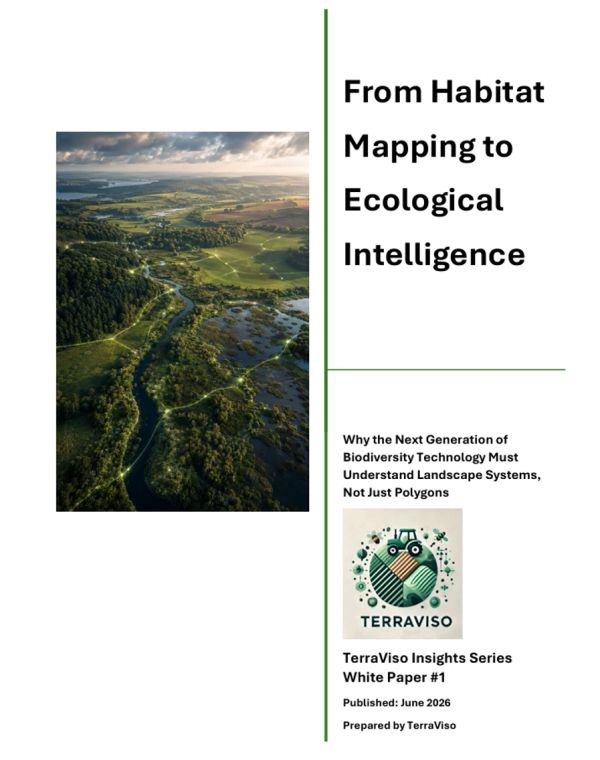
Explores why habitat mapping is only the beginning, and how understanding relationships across a landscape can reveal a much richer ecological picture.
White Paper 2 — Ecological Fingerprint Intelligence
White Paper 1 — From Habitat Mapping to Ecological Intelligence
White Paper 1 — From Habitat Mapping to Ecological Intelligence

Explores how measurable ecological characteristics can help identify habitat similarities, relationships and patterns that conventional habitat mapping may not reveal.
Ecology doesn't stop at the edge of a polygon

Maps often represent woodland as one polygon, grassland as another and a hedgerow as a line. Those representations are useful, but nature doesn't experience a landscape as a collection of separate GIS features.
Habitats influence one another. Their ecological role can depend on what surrounds them, how they connect and whether they form part of a larger network.
TerraViso's Ecological Intelligence looks beyond individual habitats to explore those wider relationships.
What habitats are here? is an important question.
How does this landscape work? is the question TerraViso wants to help answer.
Who TerraViso is for
TerraViso's underlying landscape intelligence also creates opportunities for emerging applications in natural capital, nature risk, finance and insurance.
Why I started TerraViso
After more than three decades working with geographic information, remote sensing and location intelligence, I've watched our ability to collect environmental data increase enormously.
But more data doesn't automatically mean better understanding.
I started TerraViso to explore whether location intelligence could help us look beyond individual datasets and habitat maps and understand the relationships that shape a landscape.
That remains the idea at the heart of TerraViso.
Andy Millard
Founder, TerraViso

Our Partners